Prompt Engineering is Dead: Here is What Actually Works in 2026
Your carefully crafted prompts stopped working. The output that took 10 iterations to work well last quarter now returns garbage on the first try. What changed?
On this page
- The Problem: Your Prompts Are Not the Problem
- The Shift: From Wording to System Design
- 1. Context Over Prompts
- 2. Schemas and Tool Calls
- 3. Measurement
- What Killed Prompt Engineering
- 1. Model Improvements Through RLHF
- 2. Automated Optimization
- What Actually Works Now
- 1. Define the Output Schema
- 2. Curate the Context
- 3. Build the Evaluation Loop
- The Honest Caveat
Jump to section
- The Problem: Your Prompts Are Not the Problem
- The Shift: From Wording to System Design
- 1. Context Over Prompts
- 2. Schemas and Tool Calls
- 3. Measurement
- What Killed Prompt Engineering
- 1. Model Improvements Through RLHF
- 2. Automated Optimization
- What Actually Works Now
- 1. Define the Output Schema
- 2. Curate the Context
- 3. Build the Evaluation Loop
- The Honest Caveat
The models got better. Not just at following instructions. At ignoring the instructions that do not matter. Reinforcement Learning from Human Feedback absorbed the tricks. Persona stacking, emotional cues, tree-of-thought incantations. All the techniques that felt like magic in 2024 are now noise. The models learned them. Then they learned to tune them out.
This is not about search visibility or AI Overviews. This is about the prompts you write to get work done. The ones that generate code for client projects. The ones that draft content for your agency. The ones that analyze data for your workflow. Those prompts are failing. Not because you are bad at prompting. Because the game changed.
The Problem: Your Prompts Are Not the Problem
I spent weeks refining the ideal prompt. Testing variations. A/B testing persona tricks. The output was good. Then it stopped working. Not gradually. Overnight.
The issue is not your prompt. The issue is that the model no longer needs it.
Modern LLMs understand intent. They do not need you to act as a genius expert. They do not need emotional cues. They do not need forced step-by-step reasoning. Those techniques worked when models were weak. Now they are strong. The magic phrase era is over.
What happened to prompt engineering? It moved up the stack. The craft did not disappear. It evolved into system design. I saw this firsthand with client work at Code and Canvas. A prompt that generated clean React components in March produced bloated, unmaintainable code by May. The model did not get worse. It got more literal. It started following the letter of the prompt, not the spirit.
The Shift: From Wording to System Design
The winners are not obsessing over wording. They are architecting the entire information environment that feeds the model.
Here is what matters now:
1. Context Over Prompts
The prompt is now the output of a compilation step, not source code you hand-tune. DSPy from Stanford treats prompts this way. You write a program with typed signatures. DSPy compiles the prompt, optimizes the few-shot examples, and re-optimizes when you swap models.
I implemented DSPy for a content pipeline. The framework generated prompts I would never have written. But they worked. Why? Because DSPy understood the output schema better than I understood the prompt syntax. The prompt is the part that shrinks every time you tighten a schema, add a tool, or move a decision into code.
2. Schemas and Tool Calls
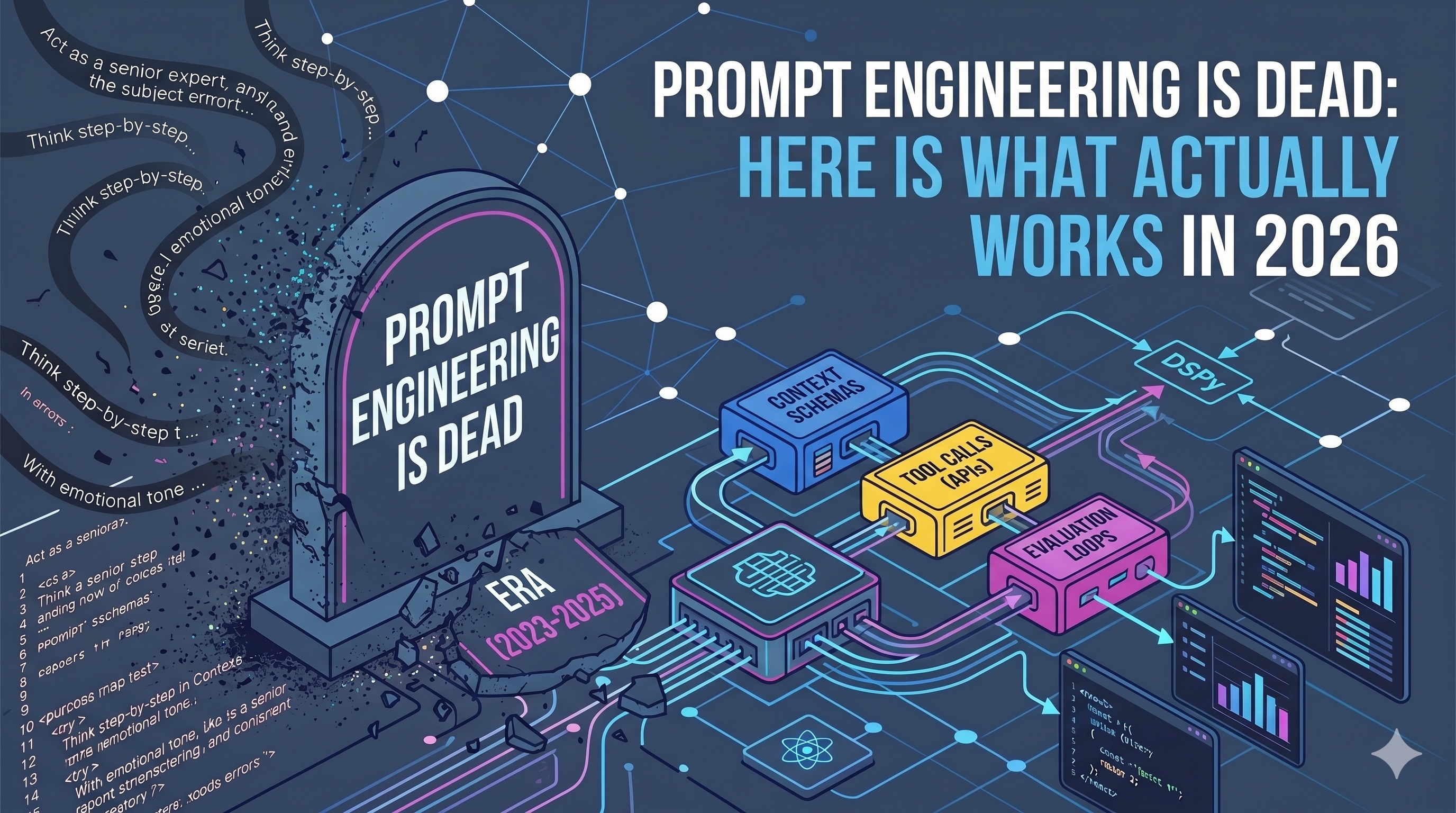
What actually works is structuring the information flow. Schemas define the shape of the output. Tool calls define the actions. Context layouts define the environment. Evaluation loops define the quality bar.
I built a system for API documentation that needed consistent structure. The old approach: write a detailed prompt, iterate, refine. The new approach: define the schema for the documentation, provide the API spec as context, let the model fill in the gaps. The result was more consistent. The process was faster. The prompts were simpler.
3. Measurement
If you cannot measure the change, you are guessing. Architecture beats adjectives. Every single time.
I added evaluation loops to my workflow. Each output gets scored against criteria. Not just does it look good. Does it meet the spec? Does it pass the tests? Does it match the style guide? The feedback loop is automatic. The improvement is continuous.
What Killed Prompt Engineering
Two forces converged.
1. Model Improvements Through RLHF
Models now understand intent more naturally. You can be loose with your wording and still get solid output. The days of obsessing over precise phrasing are behind us.
The jump from GPT-3.5 to GPT-4 showed this clearly. Prompts that required careful tuning for 3.5 worked out of the box with 4. Then GPT-4o arrived and the same prompts felt verbose. The models were not just better. They were different.
Reinforcement Learning from Human Feedback did not just improve outputs. It absorbed the techniques. The models did not just get better at following instructions. They got better at recognizing which instructions were redundant.
I noticed this with role-play prompts. Act as a senior React developer. The output was good with GPT-3.5. With GPT-4, the role-play became noise. The model already knew how to act as a senior React developer. Adding the instruction did not help. It distracted.
2. Automated Optimization
Frameworks like DSPy write and optimize instructions automatically. Letting a human manually tweak a prompt in 2026 is like trying to manually tune a car engine with a screwdriver when you have an onboard computer that does it better.
I tried DSPy on a legacy prompt set. The framework found combinations I had not considered. The outputs improved. The prompts got shorter. The system got smarter. The optimization happens at the system level, not the prompt level. DSPy does not just improve prompts. It rethinks the entire workflow.
What Actually Works Now
1. Define the Output Schema
Start with the structure you need. Not the words you want. A typed signature beats a paragraph of instructions. The model understands constraints better than it understands creativity.
For marketing copy, define the schema: headline, subhead, 3 bullet points, CTA. The prompt becomes a single sentence. Generate marketing copy for this product. The schema does the rest.
2. Curate the Context
Feed the model the right information. Not more information. The right information. Context engineering means selecting sources, not stacking prompts.
For technical documentation, provide the API spec, existing documentation examples, and style guidelines. The prompt: Write documentation for this endpoint. The context does the work.
3. Build the Evaluation Loop
Know what good looks like. Measure against it. Iterate on the system, not the prompt.
Build a scoring system for code generation. Does it compile? Does it pass tests? Does it follow conventions? The model gets feedback on each criterion. The next iteration improves. The prompt stays the same.
The Honest Caveat
System design requires new skills. Tooling like DSPy is still evolving. Measurement is difficult. But the results are worth it.
The first project took longer: unlearning habits and learning new tools simultaneously. But the second project was faster. The third was faster still. The quality improved with each iteration.
Stop refining prompts. Start building systems.